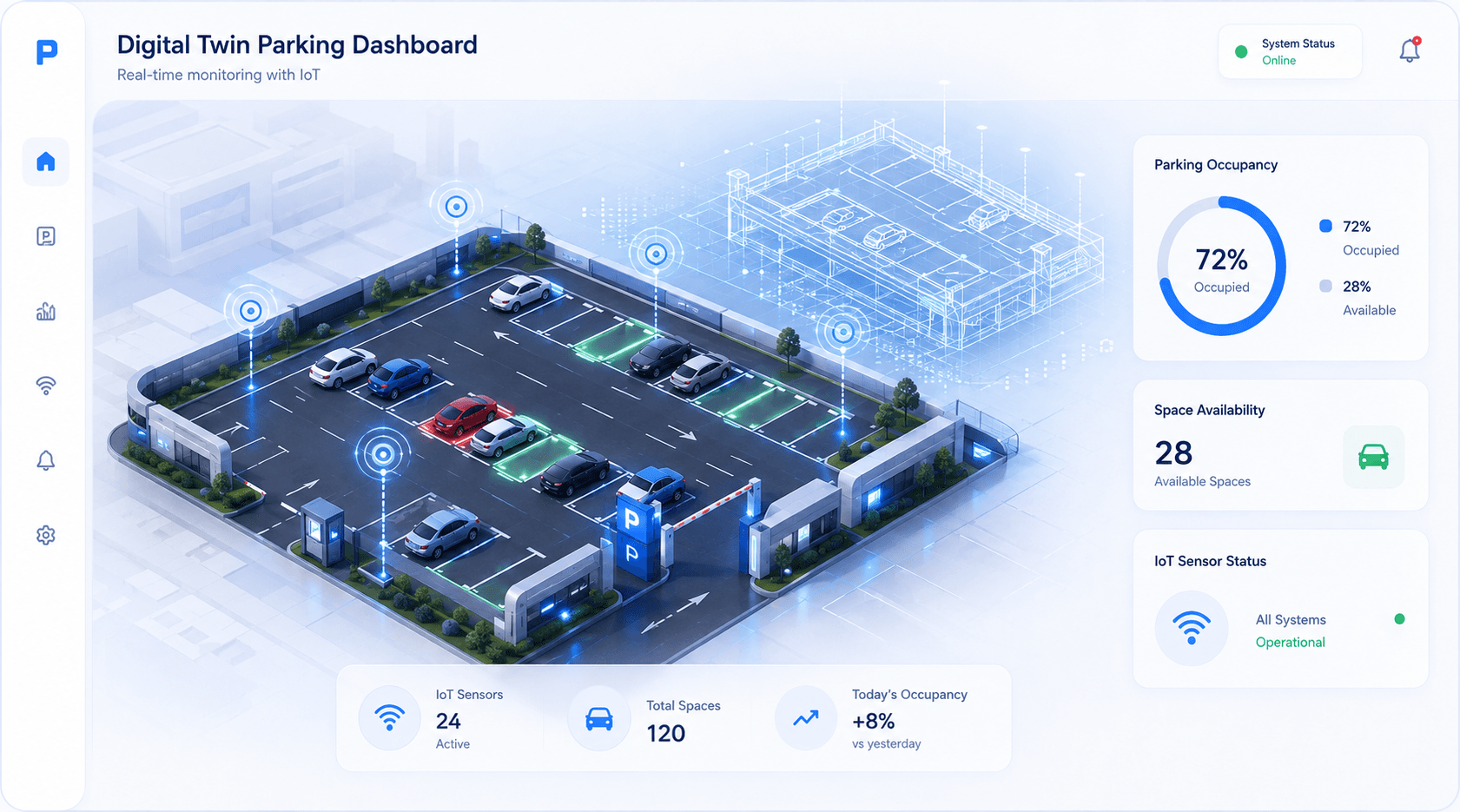
ParkingTwin
IoT occupancy · Digital twin · Real-time

The operating system for smart parking.

ParkingTwin connects physical parking facilities to IoT occupancy sensors, a unified backend, and a live digital twin — so parking owners can see, understand, and act on occupancy in real time.

SaaS · Multi-tenant · MQTT & LoRaWAN-ready

app.parkingtwin.space/twin

Digital twin · North Gate Garage

Live facility twin

Synced · live
Occupied Free ReservedLevel B1 · 35 of 336 spaces shown
Occupancy
214 / 336
64%
Sensors online
96 / 96
all reporting
Events today
41.2K
verified
Last sync
0.3s
twin in sync
SensorsEdgeBackendTwin

pipeline healthy

Event stream

  • 10:42:13.004B-12 → occupied
  • 10:41:58.210A-03 → free
  • 10:41:36.102sensor batch acked

How it works

From physical space to digital twin

A single, connected pipeline turns a conventional parking facility into live, observable digital infrastructure.

01

Physical parking

Parking facilities, lots, and garages prepared as the source of truth for occupancy.

02

Occupancy sensors

IoT sensors report whether each parking space is occupied or free, in real time.

03

IoT communication

A dependable connectivity layer built for MQTT, LoRaWAN, and webhooks.

04

Backend & data

A real-time backend ingests, validates, and stores occupancy events as they arrive.

05

Digital twin

A live digital replica of the facility, continuously synchronized with reality.

06

Real-time visualization

Dashboards and facility maps surface parking status the moment it changes.

The solution

A closer look at how ParkingTwin works

A smart parking solution is only as good as the data behind it. ParkingTwin is built as a complete vertical slice of a real product — from the sensor in the space to the dashboard on an operator's screen — so every layer is designed with production in mind.

01

Sense — occupancy at the edge

Every space reports its own state.

At the edge of the platform sit the parking spaces themselves. Each space is fitted with an occupancy sensor that detects whether a vehicle is present. Sensor types vary by environment — ultrasonic and radar for garages, magnetic loops embedded in open lots, camera-based detection in multi-level structures — and the platform is deliberately sensor-agnostic.

What matters is the message contract, not the hardware. Every sensor reports a facility identifier, a zone and slot, a timestamp, and a confidence level. Whether the physical layer is simulated, retrofitted, or built in from day one, the platform accepts the same events, which is exactly what makes the architecture future-proof.

02

Connect — MQTT, LoRaWAN, webhooks

Events stream in; nothing is polled.

Sensors push updates over a connectivity layer rather than being polled. MQTT is the workhorse for facilities with reliable IP networks — lightweight publish/subscribe messaging that moves thousands of occupancy events per minute. LoRaWAN covers the long-range, low-power case, letting battery-powered sensors report from every level of a garage for years without external power.

Webhooks let third-party platforms push events in, and edge gateways buffer and batch messages when connectivity drops, replaying them once the link returns. The result: the digital twin never silently misses an event, even across flaky networks.

03

Process — backend and digital twin

A live model, kept in sync by the ingestion pipeline.

Events land in a real-time backend that validates, deduplicates, and stores every state change, attaching an exact timestamp at ingress. From that stream, the digital twin is maintained: a live, queryable model of the facility in which every slot has a current state — occupied, free, or reserved — alongside its geometry and metadata.

Because the twin is a model rather than a static diagram, it supports snapshots in time, answers questions like “what did Level 1 look like at 5 p.m. on a rainy Tuesday?”, and acts as the single source of truth for every view in the system. Multi-tenant isolation keeps each operator’s facilities, channels, and settings strictly separate.

04

Operate — dashboards, analytics, SaaS

See it live, then learn from it.

Operators experience the twin through two lenses. A real-time dashboard renders occupancy as it happens — utilization totals, per-slot state mapped onto the facility plan, and live alerts when a level fills up. An analytics layer answers the longer view: where occupancy peaks, where queues form, and whether pricing or layout changes actually moved the needle.

Because every event is time-stamped and stored, historical reporting is exact rather than sampled. Underneath it all, the platform runs as a multi-tenant SaaS: operators manage facilities, users, roles, and alerts from a control plane, and the same instance scales from a single lot to a city-wide portfolio.

ParkingTwin isn't a landing page concept — it's a working vertical slice that runs today. The same pipeline that powers the live facility map is designed to accept real sensor hardware as soon as it ships, which makes it the foundation for the complete smart parking product rather than a demo that gets thrown away.

See ParkingTwin on your own facility.

Get a personalized walkthrough of the live dashboard, the digital twin, and the roadmap.

Request a demo